5 Stupid Implications of YouTube's Video Muting:
"Yesterday we broke a story about YouTube muting videos that use unauthorized copyrighted music as the audio. Since then, users have been trying it out with dozens of copyrighted audio tracks and it seems that this will definitely happen often in the future, as the library of “banned” music is quite extensive.
I don’t understand why any copyright holder could prefer removing his/her audio track to simply slapping some ads and trying to monetize the fact that someone, somewhere, likes their song. But what I do know is that YouTube has brought forth a number of interesting memes and phenomenons which will die out if this new audio muting practice continues (and spreads to music from other labels, not just Warner). Here are some of the obvious ones:
1. No more RickRoll (or any other authentic viral videos with copyrighted music)
By this, I don’t mean the actual rickroll, that is, tricking people into clicking on a link with Rick Astley’s song Never Gonna Give You Up. I mean all similar, past and present jokes and memes that use a popular, copyrighted audio tune. Whether you like the RickRoll jokes or not, you’ve got to admit that the world is just a tiny bit more boring place without them.
Sure, some viral videos don’t use copyrighted music. But many do: Numa Numa,"
5 Stupid Implications of YouTube's Video Muting
And I thought I was going crazy when we couldn't hear any of the videos I had prepared for the lesson... I should have downloaded them, that'll teach me...

A Portal to Media Literacy
Presented at the University of Manitoba June 17th 2008. (for those of you waiting for the Library of Congress presentation, it will be posted July 19th-ish.)
From Stephen's Lighthouse:
http://stephenslighthouse.sirsidynix....
"Many of you have probably seen Kansas State University prof Michael Wesch's thought-provoking video, "A
Vision of Students Today". http://www.youtube.com/watch?v=dGCJ46...
Recently Dr. Wesch spoke at the University of Manitoba where he explained the the basis of this video in a talk entitled, "Michael Wesch and the Future of Education." I found it fascinating! He describes how he so naturally incorporates emerging technologies into his courses from the smallest seminar type class to the largest lecture theatre filled class.
More importantly he not only talks about the technologies but how he encourages extraordinary participation and collaboration from his students by engaging them in meaningful learning activities.
Although the video is 66 minutes long...pour a coffee, iced tea or glass of wine and enjoy this dynamic presentation from a master teacher."
http://umanitoba.ca/ist/production/st...
Dubbed "the explainer" by popular geek publication Wired because of his viral YouTube video that summarizes Web 2.0 in under five minutes, cultural anthropologist Michael Wesch brought his Web 2.0 wisdom to the University of Manitoba on June 17.
During his presentation, the Kansas State University professor breaks down his attempts to integrate Facebook, Netvibes, Diigo, Google Apps, Jott, Twitter, and other emerging technologies to create an education portal of the future.
"It's basically an ongoing experiment to create a portal for me and my students to work online," he explains. "We tried every social media application you can think of. Some worked, some didn't."
Martin Luther King, Jr. - Wikipedia, the free encyclopedia
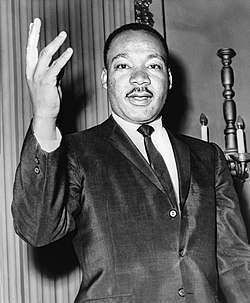
Martin Luther King, Jr. - Wikipedia, the free encyclopedia:
"Martin Luther King, Jr. (January 15, 1929 – April 4, 1968) was an African American clergyman, activist and prominent leader in the American civil rights movement. His main legacy was to secure progress on civil rights in the United States and he is frequently referenced as a human rights icon today.
A Baptist minister,[1] King became a civil rights activist early in his career. He led the 1955 Montgomery Bus Boycott and helped found the Southern Christian Leadership Conference in 1957, serving as its first president.
King's efforts led to the 1963 March on Washington, where King delivered his “I Have a Dream” speech. There, he raised public consciousness of the civil rights movement and established himself as one of the greatest orators in U.S. history.
In 1964, King became the youngest person to receive the Nobel Peace Prize for his work to end racial segregation and racial discrimination through civil disobedience and other non-violent means. By the time of his death in 1968, he had refocused his efforts on ending poverty and opposing the Vietnam War, both from a religious perspective.
King was assassinated on April 4, 1968, in Memphis, Tennessee. He was posthumously awarded the Presidential Medal of Freedom in 1977 and Congressional Gold Medal in 2004; Martin Luther King, Jr. Day was establi"
Printables:
http://homeschooling.about.com/od/holidays/ss/mlkingprint.htm
Subscribe to:
Posts
(
Atom
)